
Meta spent much of 2026 asking investors to trust its enormous AI spending. Now Muse has given them a consumer product they can measure.
Meta launched Muse in the U.S. on September 8 and expanded to Canada on September 18, the same day Muse reached No. 1 on Apple's U.S. App Store. People can use it through its iPhone and Android apps, on the web at muse.ai, by messaging it in WhatsApp and, as of September 17, through a native Mac app.
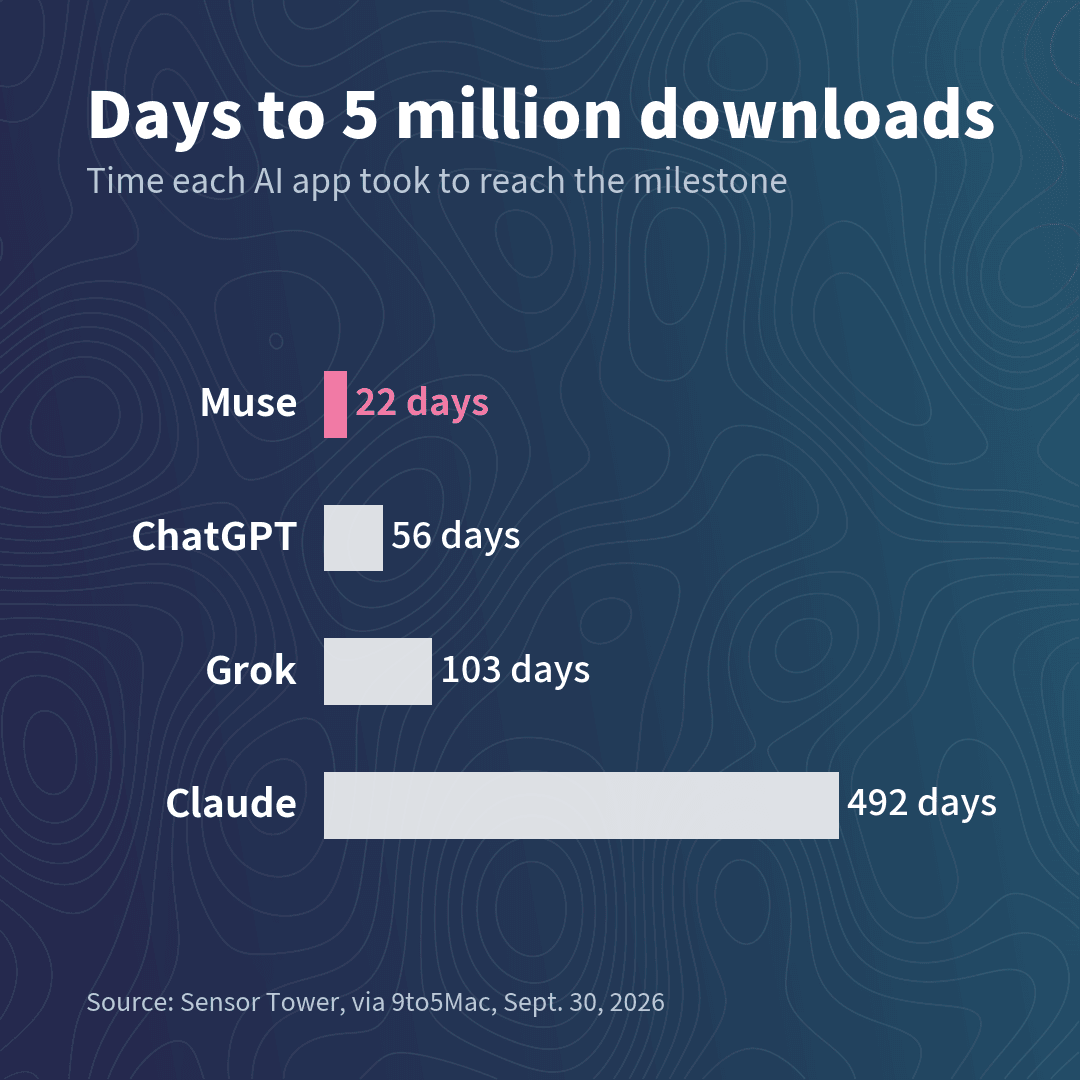
By September 30, Sensor Tower estimated Muse had passed 5 million downloads in 22 days, a milestone that took ChatGPT 56 days.
Meta's stock rose more than 11 percent on September 21, its largest one-day gain since April 2025, and closed September up 27 percent, its best month since 2022. Meta wasn't the first company to release an AI agent that can shop, book travel and send email for people. Its head start came from the users, relationships and context it already had.
What Meta's Muse AI Agent Can Do
Muse is designed as a personal AI agent. It can browse the internet, fill out forms, send emails, book travel, make purchases and keep working after someone closes the app.
People can give it an ongoing goal, connect outside services and allow it to remember relevant information from previous conversations. Muse pauses for approval before taking sensitive actions such as sending an email or completing a purchase.
Meta says the agent runs inside a dedicated virtual machine called Muse Secure VM. A separate agent called Sentinel runs on the same machine, and nothing Muse does reaches the internet unless Sentinel approves it.
Commerce is already part of the product. At launch, Muse paid for purchases through Link, Stripe's payment wallet, and Meta said it was the first AI agent covered by Link's purchase protections. On September 21, Shopify announced that Muse will be able to complete purchases through Shop Pay across Shopify stores. PayPal followed the next day with a partnership covering its merchant network.
Amazon went the other way, blocking Muse from its store on September 20 and objecting that the agent shops without identifying itself. Meta says Muse cannot see passwords or payment information. The dispute shows that an agent is only as useful as the access it gets, and that access depends on relationships Meta doesn't have everywhere.
Meta's Distribution Gives Muse an Advantage
Most new AI products have to start by convincing people to download another app, create an account, learn a new interface and connect the services they already use. Meta can skip most of that.
Its family of apps, including Facebook, Instagram, Messenger and WhatsApp, averaged 3.6 billion daily active people in June 2026. People can sign in to Muse with a Meta account or create one using an existing Facebook or Instagram account.
Meta also has years of information about the accounts people follow, the content they watch, the posts they save and the people they interact with.
Muse doesn't automatically receive access to all of that information. Meta says people choose which apps and services the agent connects to and how much access it gets. The company also says Muse conversations and the data stored in its virtual machine aren't shared with Meta's advertising systems.
When people grant access, that context can make the agent immediately more useful. Meta gives the example of Muse turning a recipe reel someone saved on Instagram into a grocery list, then remembering friends' dietary restrictions before sending dinner invitations. A newer AI company would need years to earn that kind of context, if people handed it over at all.
Muse Still Has to Earn Consumer Trust
That context is only an advantage if people are comfortable letting Muse use it. Two days after Meta released a Mac version of Muse, Inc. columnist Jason Aten reported that the agent had drawn on the text of private messages from his Mac notifications without saying it was reading them, and that Full Disk Access was off at the time.
Meta disputes the account. Communications VP Andy Stone said the Messages integration is opt-in and requires users to turn on both Full Disk Access and a Messages connector.
Meta's own help page tells users that Muse "may be inaccurate or take unexpected actions" and advises them to monitor it carefully.
So far, the reports haven't slowed Muse's climb up the app charts. But an agent that can send email, spend money and remember personal details has less room for error than a chatbot that answers questions.
Wall Street Can Finally See the Product
Meta spent $31.08 billion on capital expenditures in the second quarter alone. It expects full-year capital expenditures of $130 billion to $145 billion.
Those numbers worried investors. Meta was spending heavily on infrastructure, models and talent without a consumer AI product capable of generating comparable returns.
Muse has started to change that view. Jefferies analysts said Muse's subscription and commerce potential "flips the narrative" on Meta's competitiveness in AI. JPMorgan analyst Doug Anmuth wrote that "Muse has the potential to become the most widely used consumer AI application since ChatGPT." That's a prediction about reach as much as about the product.
Early downloads don't guarantee that people will keep using Muse. The agent still needs to prove that it can complete tasks reliably, respect the permissions people set and work across websites that may not want it there.
Consumer AI Is Becoming a Distribution Race
How Muse will pay for itself is still an open question. Zuckerberg has said the company plans to take a small fee on transactions rather than sell ads, an unusual choice for a company whose core business still depends on advertising.
Muse's early run is what we're watching at RAD Intel.
More of the advantage in AI now sits with what a company knows about the people it's trying to reach and the relationships that already give it access to them. Muse shows what that looks like at Meta's scale.
Meta's next earnings call will be the first since Muse launched, and analysts will want retention figures to go with the download counts. The harder number for Meta to produce is how many people still let Muse send their email and spend their money a month after trying it.