
Give a marketer one good data point and they’ll have a decision. Give them 20 and they’ll have a meeting.
That second scenario is becoming much more common. We can model audiences, predict performance, map behaviors, and find patterns that would have taken weeks of research to uncover a few years ago. There is, unfortunately, no corresponding button labeled MAKE THE RIGHT CALL.
At the end of the day, someone still has to decide which evidence matters. The biggest audience can be the wrong audience. The most impressive number can send you chasing something that has very little to do with what you’re trying to accomplish. And occasionally, the new information you were waiting for arrives only to make you more certain about the decision you already made.
So I wanted to know what (if anything) could make a marketer reconsider.
Across the portfolio, I gave three senior marketers the same LEGO campaign brief, asked each to make an initial recommendation, then gave all three the same audience intelligence surfaced from our platform. What happened next made “changing your mind” feel a lot less simple.

The Decision Before the Data
The starting brief was intentionally simple. LEGO was planning a U.S. creator-led awareness campaign with enough budget to prioritize one audience opportunity.
Three senior marketers approached it from different parts of our portfolio: Maria Brown, Chief Marketing Officer at RAD Intel; Tonia Au, Director of Media and PR at AVC; and Faith Howard, Senior Influencer Marketing Associate at RAD Amplify.
I kept the campaign brief deliberately vague, giving each marketer room to decide where the opportunity was. With no audience research to guide them, they went in three different directions.
Faith focused on adults with a nostalgic connection to LEGO, particularly people involved in creative, fandom, and interest-based communities. Her thinking was that nostalgia could open the door, while gaming, art, collecting, and other current interests could make LEGO relevant again.
Tonia saw an opportunity around U.S. Latino parents and young adults, with gifting as the occasion. Her idea was less about introducing LEGO and more about helping people who already knew the brand see a new place for it in their lives.
Maria started with moms of tweens interested in gaming, math, and science. She was interested in families who knew LEGO but hadn’t necessarily connected building with the interests their children were developing now.
Before we added a single piece of audience intelligence, they were already looking at the campaign differently.
Then We Opened Our AI-Driven Platform
For the second round, I ran the brief through RAD Intel’s decision intelligence platform. Marketing decision intelligence uses data and AI-driven analysis to help marketers evaluate audiences, strategies, and other choices before committing budget. In this case, the platform surfaced five audience opportunities based on interests, behaviors and cultural affinities.
Gaming Worldbuilders connected gaming, creator culture, and hands-on making.
Maker Mindsets centered on engineering, robotics, and technical creativity.
Thoughtful Lifestyle Gifters connected LEGO with gifting, design, and display.
Frame-by-Frame Creators used bricks for stop-motion, and visual storytelling.
Cultural Cartographers connected LEGO with architecture, travel, and place.
I didn’t want the exercise to become a hunt for the largest projected number. So for each marketer, we gave them the same audience descriptions, estimated sizes and Behavioral Signals.
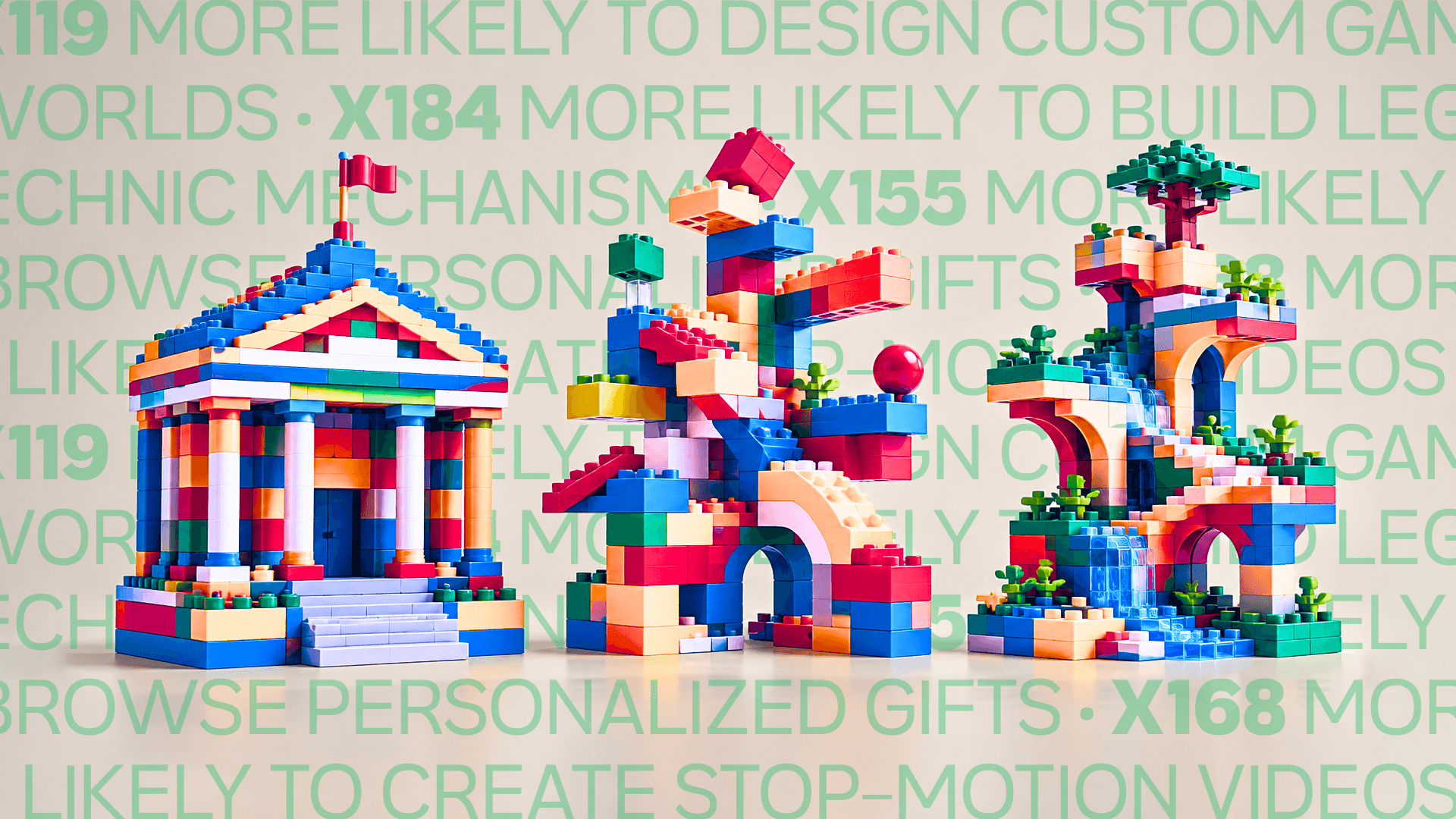
Those signals measure how much more likely an audience is to engage in a behavior than a random comparison group. Gaming Worldbuilders, for example, were 132x more likely to watch LEGO, Minecraft or Fortnite creator videos and 119x more likely to use sandbox games to design custom worlds.
With all of that in front of them, I asked what they would do now.
Where Human Judgment Entered the Marketing Decision
Faith made the clearest change. She kept the core of her original idea but narrowed her audience to adults within Gaming Worldbuilders.
Faith zeroed in on two behaviors in particular: creator viewing at 132x and sandbox worldbuilding at 119x. Together, those behaviors connected her interest in creator content with the act of making something.
Her thinking around nostalgia changed too. Initially, nostalgia helped define the audience. After seeing the intelligence, she treated it more as a possible creative angle. The audience itself could be defined by what people enjoy doing today.
Tonia did something different. She kept her original recommendation. Thoughtful Lifestyle Gifters gave her more evidence for the gifting opportunity and expanded her thinking beyond the holidays into birthdays, weddings, and other occasions. But the analysis didn’t answer what she most wanted to know about Latino parents and young adults.
“I see the audience intelligence as a reference to help refine the approach, rather than something that makes the decision for me,” she said.
Maria kept her audience too, but the intelligence changed the idea underneath it. The 119x worldbuilding behavior stood out because she saw something broader than gaming in it, a desire to create something of their own.
It led her toward a campaign built around parents noticing the clues in what their kids already make, draw, and play. A child designs a game world or sketches an invention. Later, the parent chooses a LEGO gift that lets them take that interest somewhere physical.
Apparently, 119x can mean more than one thing.
The Biggest Number Lost
Then there was 184x, easily the showiest number in the brief. Maker Mindsets were 184x more likely to build and share custom LEGO Technic mechanisms, a finding that caught both Tonia’s and Maria’s attention without changing either recommendation.
Tonia saw a specific behavior among people already engaging with LEGO, not necessarily evidence of the strongest opportunity to build new relevance. Maria made almost the same distinction. Her campaign was aimed at families that needed a new reason to consider LEGO, so evidence of existing enthusiasm didn’t answer the question she was trying to solve.
That’s the tricky thing about impressive numbers. Magnitude and relevance aren’t the same thing. A metric can be extraordinary and still be the wrong evidence for the decision in front of you.
Faith demonstrated the other side. She chose lower-indexed signals because their combination was more useful to the creator-led campaign she was building.
What This Means for Judgment
Three marketers are not a representative sample. I will save everyone the trouble of pointing that out. A different group, brand, or brief could have produced entirely different decisions.
What this gave us was a small window into how marketers decide which new information deserves to change the plan, a process that usually happens behind closed doors. Each used the intelligence to narrow an idea, strengthen an existing recommendation, or find a new way into the problem. They also recognized what the research couldn't tell them.
Marketers are going to have a lot more of those moments. AI is getting better at generating options, finding patterns, and modeling what could happen next. More intelligence can make decisions better informed without making the answer obvious.
The starting point is knowing what kind of growth you're trying to create. Evidence that people already love a brand answers a different question from evidence that could help bring new customers to it. Understanding what a behavior means in someone's life can open up new creative possibilities and give people a reason to see the brand differently. Experience and imagination can turn that understanding into an idea worth testing.
Experience needs scrutiny too. Keeping the original recommendation deserves the same examination as changing it. Marketers should be able to explain what the research strengthened, what it left unanswered, and what evidence would persuade them to take a different direction. Otherwise, more intelligence can simply give an existing preference a better argument.
If AI gives us ten plausible directions in the time it once took to develop one, choosing becomes a bigger part of the job. So does deciding how much to commit before knowing more. Teams need to agree on what to test, what success would look like, and what result would justify the next investment. That's how judgment stays accountable after the presentation ends.
Sometimes good judgment changes the plan. Sometimes it gives you more confidence in the one you already had. And sometimes it means looking at 184x and deciding you still need to know more.