
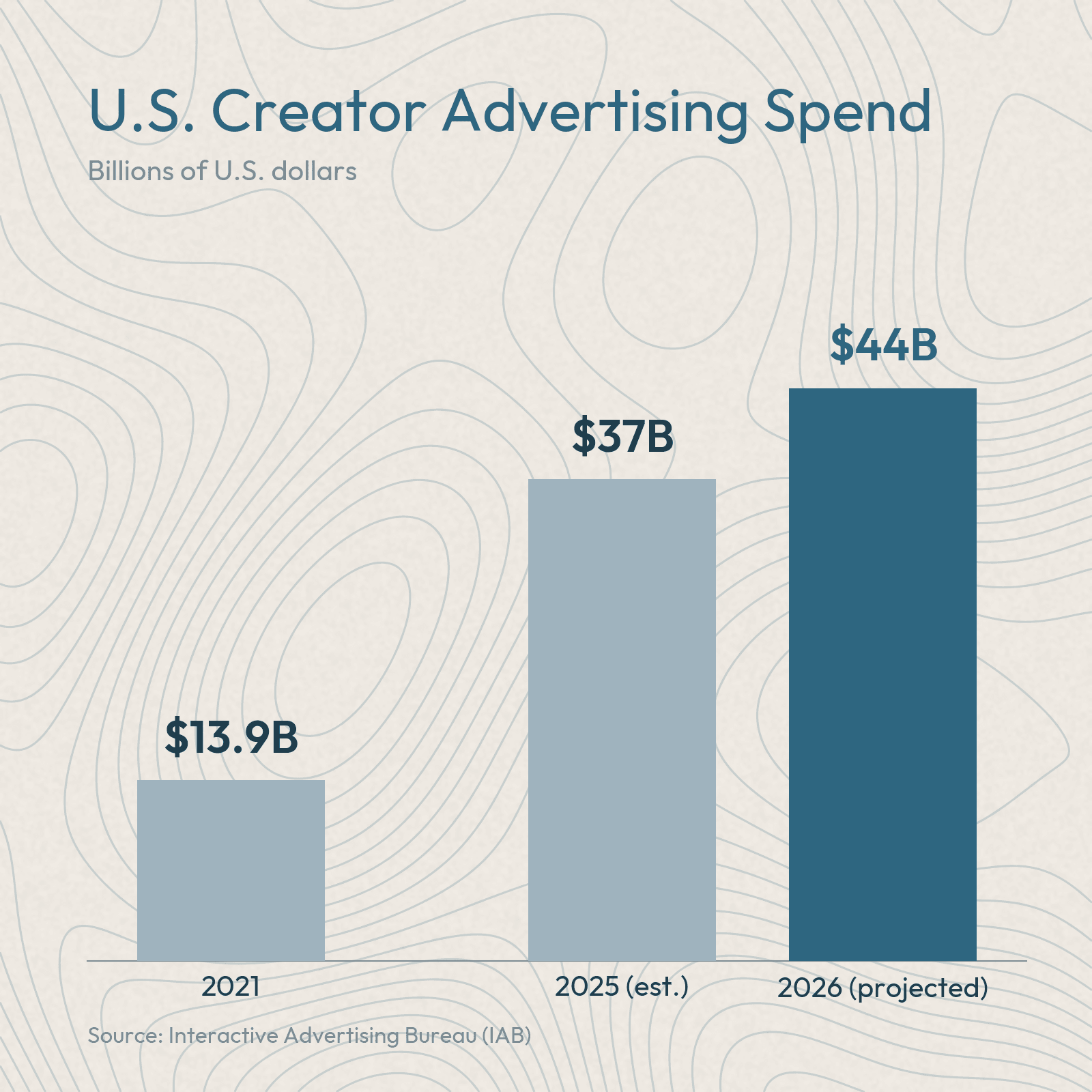
The Interactive Advertising Bureau expects U.S. creator advertising spending to reach $44 billion in 2026. In its 2025 creator economy report, IAB projected $37 billion in spending for 2025, up from $13.9 billion in 2021, and 26 percent year-over-year growth, nearly four times faster than the wider media industry.
Ramp found a similar pattern in its business transaction data. Among companies using Ramp, influencer marketing grew from approximately 0.4 percent of advertising and marketing budgets in 2023 to 1.5 percent in 2026, nearly a fourfold increase.
AI and software companies devoted 2.4 percent of their budgets to influencers and accounted for 28.2 percent of the creator spending Ramp observed, second only to consumer brands.
Ramp's data covers more than $100 billion in annual spending across more than 50,000 U.S. businesses. The company acknowledges that its customers tend to be faster-growing and more comfortable with technology than the average American business. The findings are a view of Ramp customers, not the entire economy.
Creator marketing budgets are growing, but brands are still figuring out how to spend them effectively. As creator marketing becomes a regular part of media planning, decisions about which creators to work with and which audiences to prioritize carry greater financial consequences.
Creator Marketing Is Becoming a Core Budget Investment
Kantar reports that a net 61 percent of marketers globally planned to increase creator investment in 2026.
A Northwestern University and LTK survey fielded in June 2026 covered 209 senior marketing decision-makers at brands already investing in creator marketing. Of those surveyed, 80 percent were increasing their creator budgets. One-quarter planned increases exceeding 10 percent, while only 3 percent were cutting spending.
The same study found that 91 percent of the brands ran creator programs with an always-on component. None described their programs as experimental or ad hoc.
Brands are also putting creator work to use beyond isolated social posts. The Northwestern and LTK study found that 92 percent ran creator content in social advertising. Creator content also appeared in content and email marketing, display advertising, AI-driven search, and connected television.
As creator content moves into more marketing channels, brands need to reconsider what they look for in creator partnerships. A creator is no longer necessarily producing content for a single post or campaign. Their work may support multiple marketing objectives, each with different audiences and expectations. Choosing the right partner requires understanding where that content fits into the larger strategy.
CreatorIQ found that 71 percent of surveyed organizations increased their creator budgets in its 2025 report, with average reported budgets rising 171 percent. Nearly two-thirds of the organizations increasing spending said the money came directly from paid media budgets.
These studies come from organizations with a stake in creator marketing, and their samples and methods differ. Together with IAB's 2026 creator advertising forecast and Ramp's transaction data, they show that creator marketing is becoming a regular part of advertising budgets. Brands are investing more consistently, using creator content across more channels, and putting greater pressure on their partnerships to deliver measurable results.
Creator Selection Is Struggling to Keep Up With Spending
A bigger creator budget doesn't automatically mean a smarter creator strategy. IAB says brands still struggle to select the right creators and measure business results. Kantar found that only 27 percent of the creator content it analyzed linked clearly to the brand being promoted.
The Kantar finding deserves more attention than it gets. It raises questions about how brands brief creators, communicate their objectives, and choose partners who can represent them effectively. Brands need to know what they want a creator partnership to accomplish and whether the creator's audience is a good fit.
Yet creator selection often starts with the most visible information. Follower counts, engagement rates, content style, and previous partnerships are relatively easy to evaluate. Understanding whether a creator reaches the consumers a brand actually wants to influence takes more work.
As creator budgets grow, getting the audience fit right becomes increasingly important. A creator with a large following may be a poor fit for a brand trying to reach a specific customer segment. Another creator with a smaller audience may have stronger relevance to the people the brand wants to reach.
Without a clear understanding of those audiences, brands risk investing more money in partnerships that look promising but don't necessarily support their objectives.
Audience intelligence helps brands understand the interests, behaviors, and preferences of the consumers they want to reach. Marketers can use those insights to identify creators whose content aligns with their target audiences, rather than relying primarily on follower counts or engagement rates. RAD Intel builds its creator work around that approach.
Creator marketing has already earned its place in the budget. As investment continues to grow, brands need to become more deliberate about who receives that money and why. The size of a creator's following is easy to measure. Whether they're the right person to reach a brand's customers is the real test.