

Marketers have never had so much information at their fingertips. Dashboards, forecasts, audience insights, AI recommendations. Plenty of answers, assuming everyone agrees on the question. And somehow, deciding what to do next can still be the hardest part.
Enter marketing decision intelligence. We're getting into what it means, how it works, and why all those impressive predictions are only useful if someone knows what to do with them.
What Is Marketing Decision Intelligence?
Marketing decision intelligence is the practice of using data, analytics, predictive models, and business context to evaluate marketing choices, recommend actions, and improve future decisions.
It's a discipline focused on helping marketers make more informed decisions about what to do next, using the information available to them. It brings more structure to choices marketers have traditionally made using some combination of research, performance data, experience, and professional judgment.
Marketers have to decide which audiences to prioritize, how much to spend, which creators are most likely to connect with those customers, and whether expanding into a new market makes sense.
Each decision involves incomplete information, competing priorities, and consequences that may not become apparent until weeks or months later. Decision intelligence helps marketers compare those options, estimate potential outcomes, and understand why one course of action may be preferable to another.
It builds on disciplines including business intelligence, predictive analytics, and decision theory. AI can make the process faster and more sophisticated, but decision intelligence doesn't inherently require AI. The defining characteristic is its focus on the decision itself, including how that decision is made, executed, and evaluated.
How Marketing Decision Intelligence Works
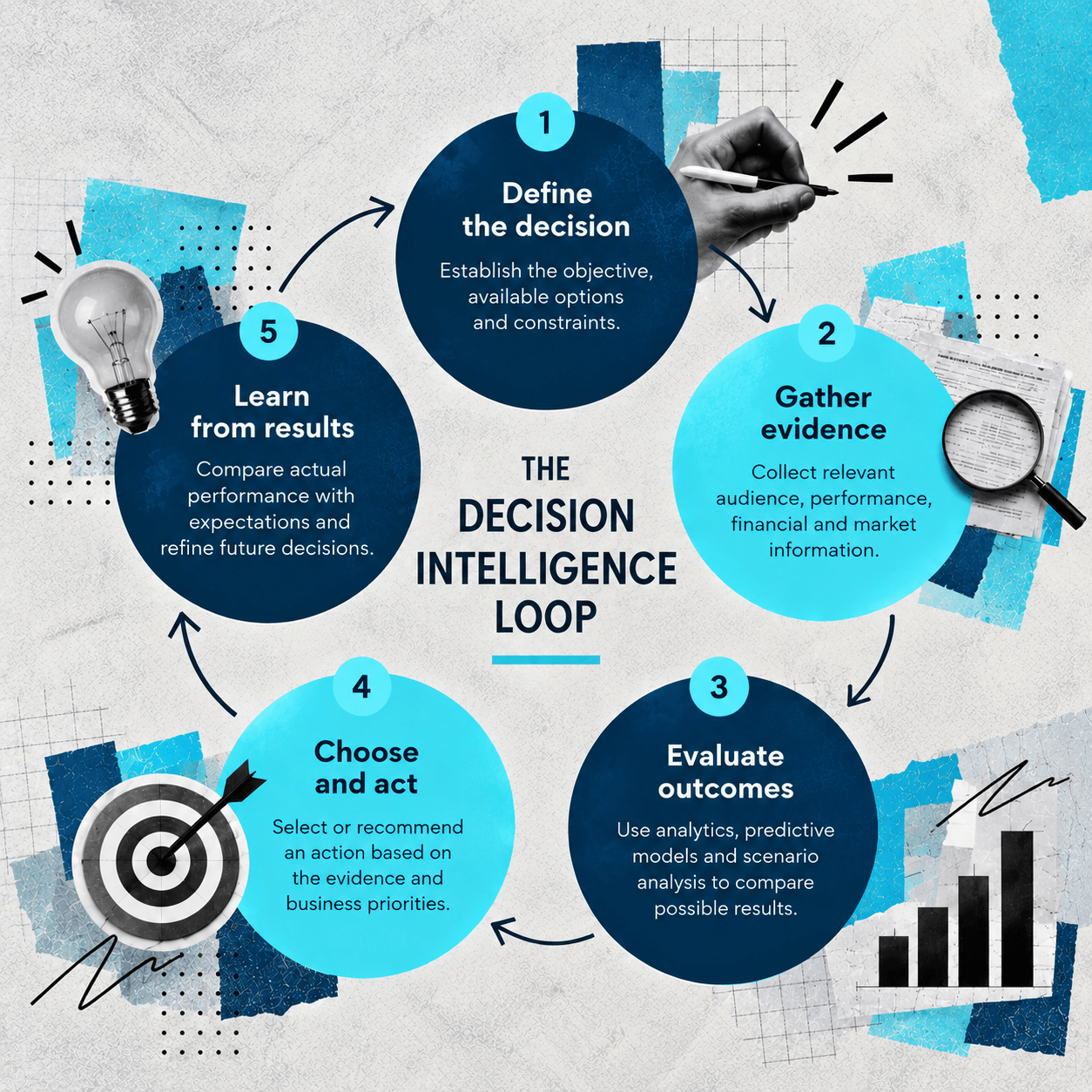
The first step is figuring out what decision needs to be made. I know, this sounds really obvious. But marketing has developed a remarkable talent for producing reports before agreeing on what anyone needs to decide.
Once the objective is clear, decision intelligence brings together relevant evidence, evaluates possible outcomes, and helps determine which action best supports that objective.
The process generally involves five steps:
1. Define the decision. Establish the objective, available options, and constraints.
2. Gather evidence. Collect relevant audience, performance, financial, and market information.
3. Evaluate outcomes. Use analytics, predictive models, and scenario analysis to compare possible results.
4. Choose and act. Select or recommend an action based on the evidence and business priorities.
5. Learn from results. Compare actual performance with expectations and refine future decisions.
Straightforward enough. But as usual, the devil is in the details. And occasionally the decimals.
An Example of Marketing Decision Intelligence in Action
Let's say you're working with a $20,000 customer acquisition budget. You've narrowed it down to two audiences, and neither is making the decision particularly easy.
Metric | Audience A | Audience B |
Predicted conversion rate | 2.5% | 1.8% |
Estimated cost per acquisition | $40 | $28 |
Estimated acquisitions with $20,000 | 500 | 714 |
Hypothetical example. Figures are illustrative, not actual campaign results.
At first glance, Audience A looks attractive. Its predicted conversion rate is higher, meaning a greater share of the people it reaches are expected to convert.
But Audience B has a lower estimated acquisition cost. Assuming the forecasts hold, that both audiences can absorb the budget, and the resulting customers have comparable value, Audience B could generate approximately 214 more acquisitions for the same investment.
If the objective is to acquire as many customers as possible within that budget, Audience B looks like the stronger choice. But suppose Audience A's customers tend to spend considerably more over time. Or Audience B is too small to support the projected investment. Suddenly, the recommendation becomes less obvious.
That's the purpose of decision intelligence. It evaluates the choices against the actual objective, including the costs, constraints, and assumptions that influence the outcome. And once the campaign runs, marketers can compare those expectations with what actually happened.
Decision Intelligence vs. Business Intelligence and Predictive Analytics
Marketing has accumulated an impressive collection of intelligence-related terminology. Business intelligence, audience intelligence, predictive analytics, prescriptive analytics, decision intelligence. There’s plenty of intelligence to go around, but it’s not always easy to understand how the disciplines differ from each other.
Underneath all the terminology, each discipline is trying to solve a different piece of the marketing puzzle.
Discipline | Main question | Marketing example |
Business intelligence | What happened, and why? | Which campaign delivered the most conversions, and what drove the difference? |
Audience intelligence | Who are these people, and what drives their behavior? | Which customer groups are interested in the category, and how do their behaviors differ? |
Predictive analytics | What is likely to happen? | Which audience has the highest predicted conversion rate? |
Prescriptive analytics | Which action is likely to produce the best outcome? | How should a fixed budget be allocated to maximize expected conversions? |
Decision intelligence | How should we make, execute, and improve this decision? | Which audience should we prioritize, given expected performance, cost, business goals, and other constraints? |
The biggest thing to keep in mind is that these approaches are complementary rather than competing.
Business intelligence helps organizations understand performance, including what happened and why. Audience intelligence provides a deeper understanding of the people behind that performance. Predictive analytics estimates potential outcomes. Prescriptive analytics, on the other hand, recommends actions, using methods such as optimization and simulation to identify the best option based on expected results and defined constraints.
Decision intelligence operates more broadly. It considers how a decision is framed, which business objectives matter, how recommendations are evaluated, who has authority to act, and what can be learned afterward.
Prescriptive analytics can be one part of that process. A model might recommend the audience most likely to generate conversions. Decision intelligence helps determine whether that recommendation makes sense for the business, given its objectives, resources, and circumstances.
Remember that a good prediction can still lead to a poor decision when the wrong factors are being considered.
The Key Components of Marketing Decision Intelligence
There isn't one universal technology stack for decision intelligence. Different organizations and platforms approach it differently. But here are the four capabilities that are especially important in marketing.
Data and Audience Intelligence
Good decisions depend on understanding the customers, the market, and the conditions surrounding a choice. That means combining relevant information from customer records, campaign performance, behavioral data, audience research, and market analysis.
Audience intelligence adds another dimension. Demographics can tell marketers who belongs to a particular group. Behavioral data can reveal what interests those people, how they engage, and where meaningful differences exist between audiences that otherwise look similar.
Of course, the quality of that information matters. Combining five unreliable datasets doesn't magically produce one reliable answer, however sophisticated the technology analyzing them might be.
Analytics and Predictive Modeling
Analytics identifies patterns, relationships, and changes in performance. Predictive models use available information to estimate what could happen next. For marketers, that might include expected engagement, conversion rates, customer acquisition costs, or campaign performance.
Scenario modeling takes the evaluation further, allowing marketers to explore how increasing the budget, changing the audience, or launching in a different market could affect performance.
These estimates are useful because they allow marketers to examine possible outcomes before spending money. But at the end of the day, they remain predictions, so their accuracy depends on the data and assumptions behind them.
Decision Modeling and Recommendations
Decision models connect possible outcomes with business objectives, available resources, and practical constraints. They help marketers compare options based on what the organization is actually trying to accomplish.
An audience with excellent predicted engagement might be the right choice for a brand awareness campaign. A different audience with stronger purchase intent could be more appropriate when immediate sales are the priority.
The recommendation should reflect those differences. Marketers also need to understand which factors influenced the result, what assumptions were made, and where uncertainty remains. A recommendation becomes much more useful when they can see what would need to change for a different option to come out ahead.
Measurement and Continuous Learning
Marketing decisions create new evidence. Decision intelligence uses that evidence to improve subsequent choices.
Comparing predicted outcomes with actual performance helps teams identify where assumptions held up, where models missed something, and what needs to change.
That feedback can inform future forecasts, recommendations, and decision processes. Because there's only so much mileage you can get out of knowing something worked. Eventually, you need to know what made it work.
Why Marketing Decision Intelligence Matters Now
Marketers have always worked with uncertainty. These days, there's a good chance another forecast will arrive before they've finished reviewing the first one.
A single campaign can involve multiple audience segments, platforms, creators, creative variations, and performance objectives. Each introduces another set of choices and potential trade-offs.
AI has expanded what marketers can analyze and predict. It has also made it easier to generate recommendations at a scale that would have been difficult to manage manually. But more recommendations don't automatically make choosing easier.
A model might identify an opportunity a team hadn't considered. It might also reinforce an outdated assumption, overlook a business constraint, or produce a forecast that looks more certain than the underlying evidence warrants.
Decision intelligence gives marketers a framework for evaluating those outputs against their actual priorities. That has several practical benefits:
More deliberate spending. Teams can compare expected outcomes and costs before allocating budget.
Faster evaluation. Marketers can assess more potential approaches without manually rebuilding the analysis every time something changes.
Greater accountability. Documenting the evidence and reasoning behind decisions makes them easier to explain, revisit, and improve.
Better adaptation. As new information becomes available, teams can update their assumptions and adjust their approach.
None of this guarantees that every decision will work out. Markets change, customers surprise us, and sometimes an excellent plan meets reality and loses. But it’s worth understanding whether the decision or the circumstances were to blame before everyone starts rewriting the strategy.
Marketing Decision Intelligence Use Cases and Examples
Decision intelligence can support choices throughout the marketing process. Here's where that starts to get practical, from choosing the right audiences to figuring out where the next marketing dollar should go.

Audience Targeting and Creator Selection
Finding a promising audience is one thing. Figuring out which message or creator will actually connect with them takes a little more digging.
At RAD Intel, we start with the audience a brand needs to reach, then evaluate which creators, content, and channels are best suited to reaching them.
That audience-first approach extends across our portfolio. Lickly applies decision intelligence to help marketers evaluate their options before committing resources, while RAD Amplify uses predictive creator intelligence to inform creator selection and campaign strategy.
Influencer marketing is a particularly good example. A creator might have a million followers, impressive engagement, and a very convincing media kit. None of that tells a brand whether those followers are the people it's actually trying to reach.
Audience intelligence helps marketers look beyond the creator's popularity to understand who's paying attention, what matters to them, and how they're likely to respond.
A creator with a smaller following may be the stronger investment, particularly when their audience is more relevant to the brand's objectives and the expected performance justifies the cost.
Creative Strategy
Creative teams make judgment calls constantly. There's always another concept worth exploring, a message to refine, or an idea that might be just risky enough to work.
Decision intelligence can bring audience preferences, predictive performance estimates, and scenario comparisons into those discussions. It gives teams a chance to see how different creative directions might perform before committing to production.
And occasionally, the data will suggest revisiting the idea that got cut from the original brief. Awkward? Perhaps. Useful? Absolutely.
Budget and Channel Allocation
When several campaigns or channels compete for limited resources, decision intelligence can help estimate the consequences of different allocations.
A marketer might discover that increasing investment in an existing campaign offers diminishing returns, while another audience or channel presents stronger expected growth. The recommendation depends on the objective, the available budget, and the uncertainty surrounding the forecasts.
Market Expansion
Before entering a new market, marketers can compare potential audiences, competitive conditions, media costs, and expected demand.
The analysis helps marketers evaluate which opportunities are most promising and what different expansion strategies could mean for the business. It also provides a basis for revisiting those choices when market conditions or customer behavior change.
Where Human Judgment Fits In
There's something appealing about the idea that sufficiently sophisticated AI could make marketing decisions for us. Feed it the right information, ask the right question, and receive the right answer.
The trouble is that marketing decisions involve more than finding the statistically strongest option. They involve brand identity, customer relationships, creative ambition, commercial priorities, and an assortment of considerations that don't always fit neatly into a model.
Human judgment brings context and experience to those decisions, along with a few biases and assumptions that can be surprisingly difficult to shake.
Which makes it particularly interesting when a model recommends something nobody expected.
Maybe it's picked up on a change in audience behavior. Maybe it's missing something the team knows from experience. Or perhaps last year's brilliant strategy has finally overstayed its welcome.
Decision intelligence gives marketers a way to investigate those possibilities before committing to a course of action. They can examine the assumptions behind a recommendation, compare potential outcomes, and understand what they're giving up by choosing one option over another.
And the process doesn't end once the campaign goes live. Results become another piece of evidence, helping marketers understand what happened and what they might approach differently next time.
Sometimes a perfectly reasonable decision leads to a disappointing result. Other times, a questionable strategy works out beautifully, and everyone congratulates themselves.
Marketing decision intelligence gives marketers a way to look beyond the outcome and understand how they got there. The assumptions, the alternatives, the trade-offs, and the information available at the time all matter. Especially when hindsight starts making everyone look a little smarter than they actually were.