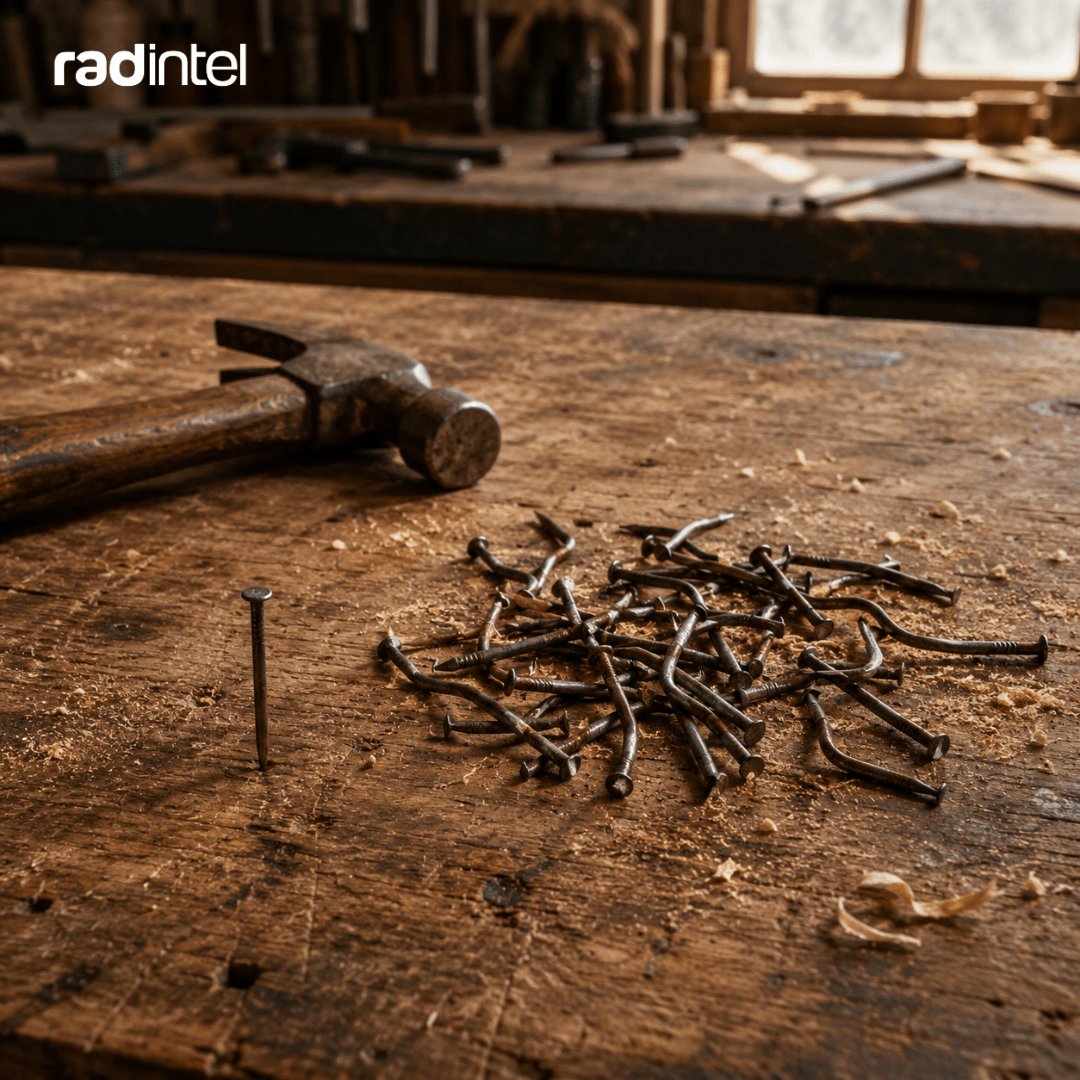

Our recruiter shared an image this week on LinkedIn that made me stop scrolling. A hammer hangs above a row of nails. Most of them are bent. Only one sits perfectly straight. The caption reads, "Mistakes are proof that you're trying."
I liked it immediately. But the more I looked at it, the more I found myself thinking about the bent nails. Nobody ends up with a handful of them without building something.
I've spent the last year at RAD Intel watching companies get built. Not one company, but several. New products. New teams. New acquisitions. New systems. Every week seems to introduce another decision that has to be made before anyone has perfect information. After a while, mistakes stop feeling unusual. They're woven into the process of building something new.
The Reality of Building
People also have a habit of rewriting startup stories after they work. Every pivot becomes strategy. Every lucky break becomes foresight. Every late-night scramble somehow turns into a carefully executed plan. Success has a funny way of making uncertainty disappear in hindsight.
The reality though? It’s considerably messier. Building a business means making decisions before you know whether they're the right ones. You hire people for roles that will evolve as the company grows. You create processes knowing they'll eventually be replaced. You launch products that won't look the same six months later because customers inevitably teach you something you couldn't have learned inside a conference room. That's the reality of building something that didn't exist before. By then, you've spent months shaping it, questioning it, revising it, and slowly bringing it to life.

At RAD Intel, we've been experiencing that at multiple levels simultaneously. Every operating company has its own customers, its own roadmap, and its own priorities. At the same time, we're building the infrastructure that connects those businesses together, allowing them to benefit from shared technology, shared operational thinking, and shared experience.
There isn't a manual for that. Much of it gets built the same way every startup builds anything meaningful: one decision at a time. Some weeks it feels like we're building infrastructure just ahead of the teams that need it. Other weeks the teams move first and the infrastructure catches up. Neither is wrong. That's just what growth looks like when several businesses are moving at once.
Perfection Is Usually a Delay Tactic
After watching companies grow, one lesson keeps showing up: perfection is expensive. It delays launches that could have generated customer feedback. It postpones hiring while teams wait for someone who checks every imaginable box. It stretches conversations because everyone hopes one more meeting will produce a perfect answer.
Most of the time, it doesn't. Markets don't slow down while companies search for certainty. Customers don't pause their expectations because an internal debate is still happening. The cost of waiting is often much higher than the cost of making a thoughtful decision and improving it later.
That doesn't mean moving recklessly. Good companies don't confuse speed with discipline. But they also understand that some questions can only be answered by doing the work. You can debate a product launch for months, but the first hundred customers will teach you more than another month of internal discussion ever could.
Almost every founder I know can point to decisions they wish they'd made sooner. Very few regret making a thoughtful decision with the information they had at the time. At some point, you have to let the work teach you something.
The Best Organizations Learn Out Loud
What happens after a mistake is usually more important than the mistake itself. A campaign that underperforms tells you something about your audience. A hiring decision that doesn't work sharpens your understanding of the role. An acquisition uncovers integration challenges that become easier to solve the next time around.
Every imperfect decision leaves behind something valuable if you're willing to capture it.
That's one of the advantages of a holding company model. Every operating company is constantly generating experience. Sometimes that experience comes from success. Sometimes it comes from discovering a better way to do something after the first attempt didn't go as planned. Either way, those lessons shouldn't stay where they originated.
If one company develops a stronger onboarding process, every company should benefit from it. If another learns something about campaign execution, customer acquisition, or operational efficiency, that knowledge shouldn't live in someone's notebook or disappear when a project ends. Over time, those lessons should become part of how the portfolio operates.
That's what compounding intelligence looks like in practice. Every company leaves the portfolio a little smarter than it found it.
Building Better Decisions
The more companies you watch grow, the less interesting the mistakes themselves become. It’s much more interesting watching how quickly they learn from them.
Organizations pull ahead one decision at a time. They learn something, apply it, and carry it into the next challenge. Those lessons shape a lot of how we think about building at RAD Intel.
We want people to think carefully, move deliberately, and stay curious enough to change their minds when new information deserves it. We want every operating company to contribute more than revenue or products. We want each one to make the businesses around it a little smarter than they were the day before.
I still have that image saved. It reminds me that building was always the goal. If a few bent nails show up along the way, that's just a sign the work is actually happening.